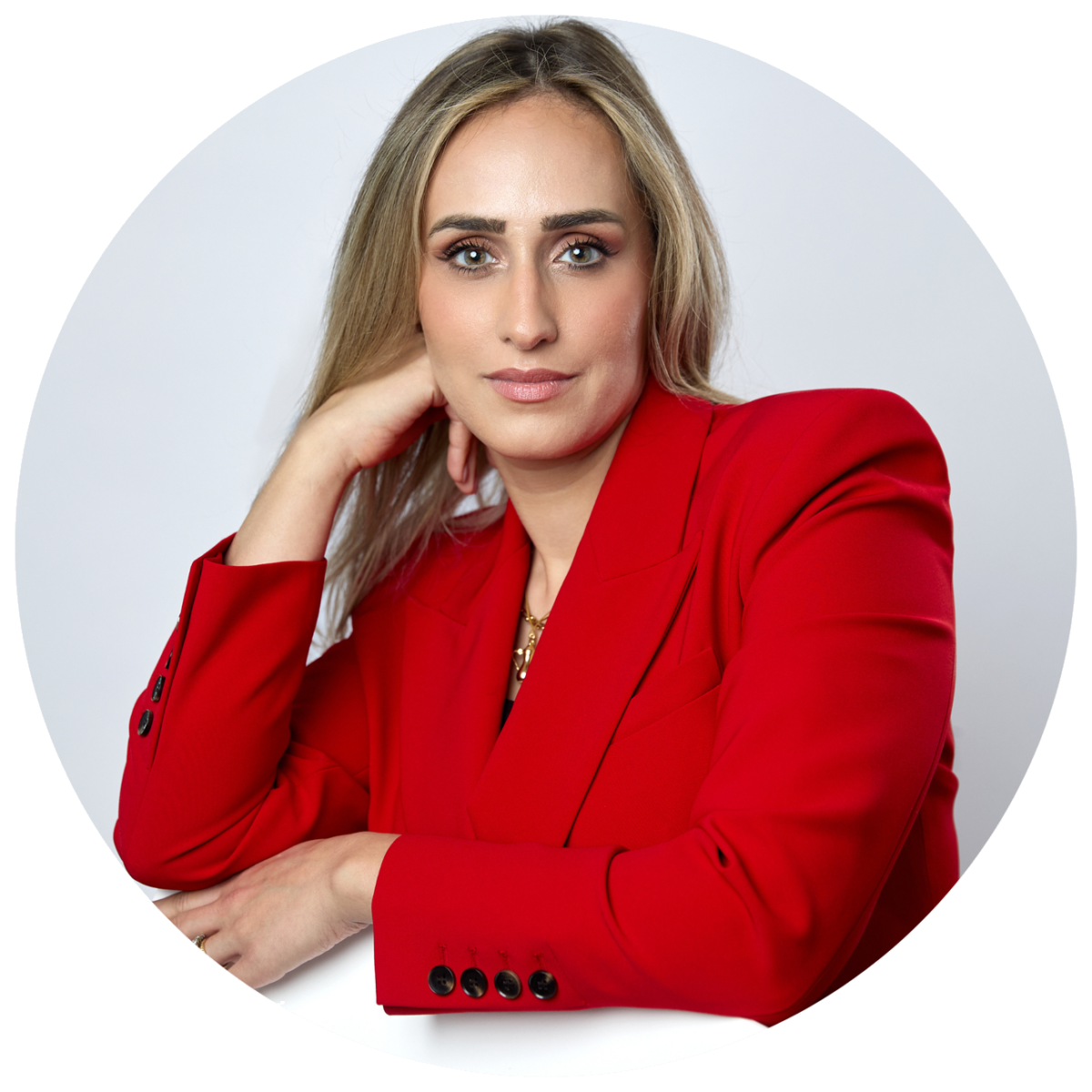
For Aya Al-Kubaisy, the future of pharmacy is about using technology to create more room for what matters most: clinical judgment, meaningful conversations and human connection.
Today, Aya works in primary care with the Hamilton Family Health Team, focusing on medication optimization, polypharmacy and supporting older adults. Alongside her clinical work, she is developing DeRxAI with co-founder Professor Mohammed Al-Khafaji. Her ambition is to help health-care professionals navigate complex medication decisions while keeping the person behind the medication list at the centre of care.
That purpose took root early. Growing up in a family of healthcare professionals, Aya was drawn to pharmacy’s combination of science, problem-solving and the opportunity to make a meaningful difference in people’s lives. Her father, a consultant psychiatrist, encouraged her curiosity about medicine, while her experience working in a hospital offered an early glimpse into pharmacists’ clinical impact.
By age 16, she knew she wanted to become an ICU pharmacist.
Although her career led her into primary care, that interest in complex clinical care remained. Mentorship helped shape her approach. Her father taught her to see patients as people rather than diagnoses, while her mother instilled the importance of kindness, empathy and giving others grace. Her pre-registration training supervisor in the UK, Yuen Toh, encouraged her to be ambitious and confident without compromising kindness.
Since moving to Ontario, her colleague at the Hamilton Family Health Team, Dr. Lucy Feng, has also helped her navigate the Canadian health-care system, expand her knowledge and build connections.
That ambition has carried Aya through demanding professional milestones alongside motherhood. She completed her independent prescribing qualification in the UK while pregnant, passing on her first attempt. Later, while caring for her second baby, she completed her Canadian pharmacy equivalency examinations, with her mother and sisters helping care for her baby as she prepared for her final OSCE examinations in Toronto.
“Passing on my first attempt, despite the circumstances, made me feel incredibly proud,” Aya says. “It reinforced what is possible with determination, preparation, and support.”
A Vision for the Future
Now, Aya is applying that determination to the development of DeRxAI. The AI-enabled clinical decision-support tool is being designed to help health-care professionals identify opportunities for safer, more appropriate medication use and support deprescribing in older adults experiencing polypharmacy.
For Aya, technology offers an opportunity to strengthen, not replace, the human side of pharmacy. She believes pharmacists should help shape health technology because they understand medications, clinical risk and the realities of day-to-day patient care.
“I believe pharmacists are one of the most underused resources in healthcare,” she says. “We are trained to understand complex medication regimens, identify risks, solve problems, and explain medication information in a way that patients and other healthcare professionals can understand.”
Her vision is not simply to introduce another tool, but to support pharmacists in bringing that expertise to patient care.
Enhancing Capacity for Pharmacists
Receiving an OPA Award has encouraged Aya to become more visible within the profession and reinforced her belief in the value of pharmacists’ contributions. She sees the recognition as a reminder that work often done behind the scenes, including preventing medication-related harm, solving problems and helping patients understand their treatment, has a meaningful impact.
Looking ahead, Aya hopes to help create a more tech-forward model of pharmacy that remains deeply rooted in the community. Her vision is for pharmacies to be welcoming, accessible hubs where patients can receive trusted medication expertise, preventive care, health education and coordinated support.
“Technology should not make care feel less personal,” she says. “It should give pharmacists more capacity to build relationships, solve problems, and be present for the people they serve.”